In organic chemistry, chiral carbon atoms are essential because they can lead to different stereoisomers with different chemical and biological behavior. In SMILES notation, chirality is encoded with @ and @@, which indicate opposite stereochemical configurations at a stereocenter. Our website can visualize stereocenters directly on molecular models, making chiral information easier to see and helping users better understand 2D/3D molecular structure.
The figure above shows the molecular structure of Vitamin C. For the Vitamin C SMILES string, you can ask an AI tool such as ChatGPT or DeepSeek. The one I obtained is: OC[C@H](O)[C@H]1OC(=O)C(O)=C1O. Enter this string in the website's Manual SMILES input field.
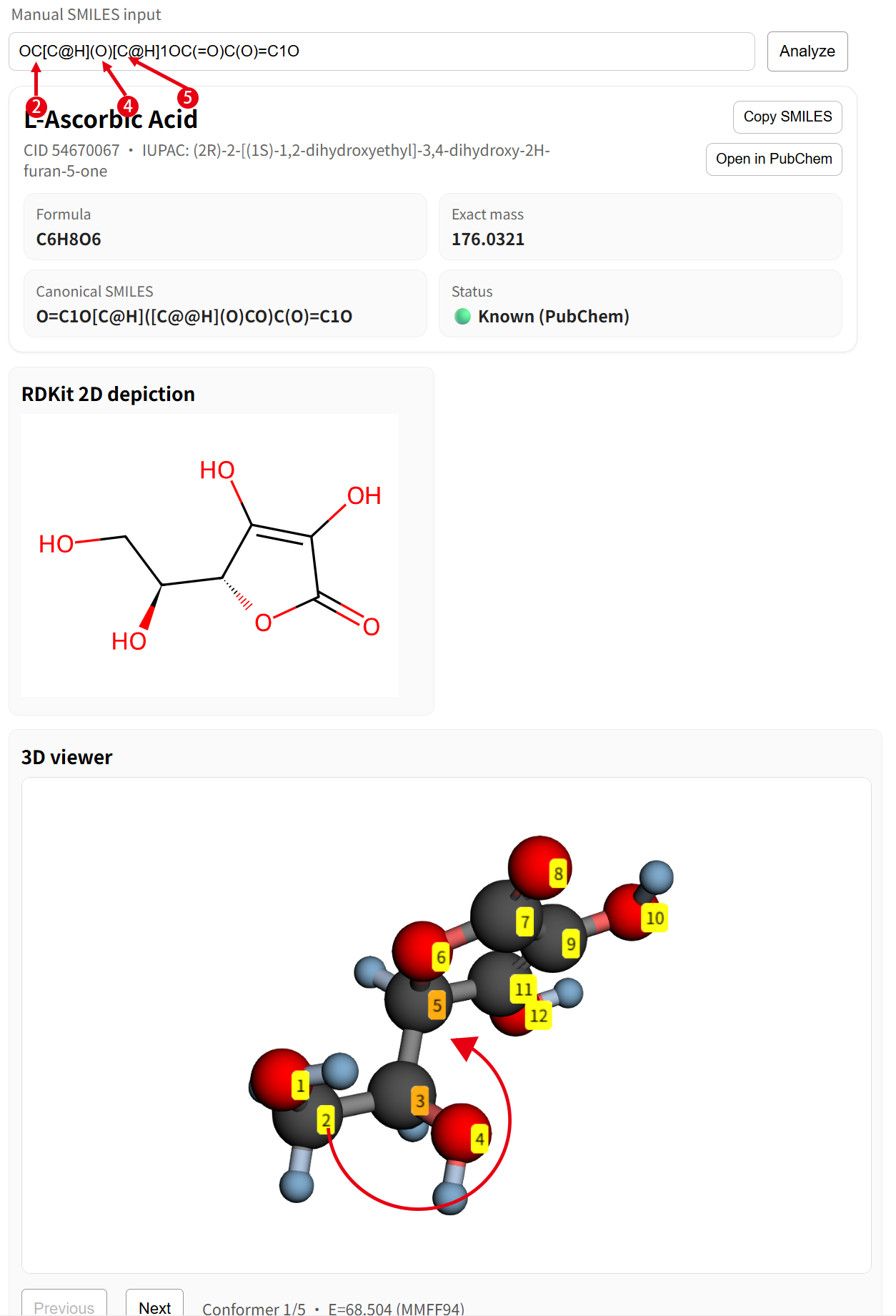
Click the Analyze button on the right. The software will query a chemical database and return the compound name L-Ascorbic Acid, then provide a canonical SMILES string, a 2D bond-line depiction, and a 3D structure. After clicking the Add Label button on the page, atom indices appear on the 3D model. Only heavy atoms are labeled; hydrogens are omitted.
Now look at the chiral carbons in Vitamin C. In orange, the software marks two chiral carbon atoms. For the first one, start from atom 2 (the atom before atom 3), then go to atom 4 (oxygen), then to atom 5 (carbon). With hydrogen oriented to the back, the sequence is counterclockwise, which matches the meaning of the "@" symbol in the SMILES notation.
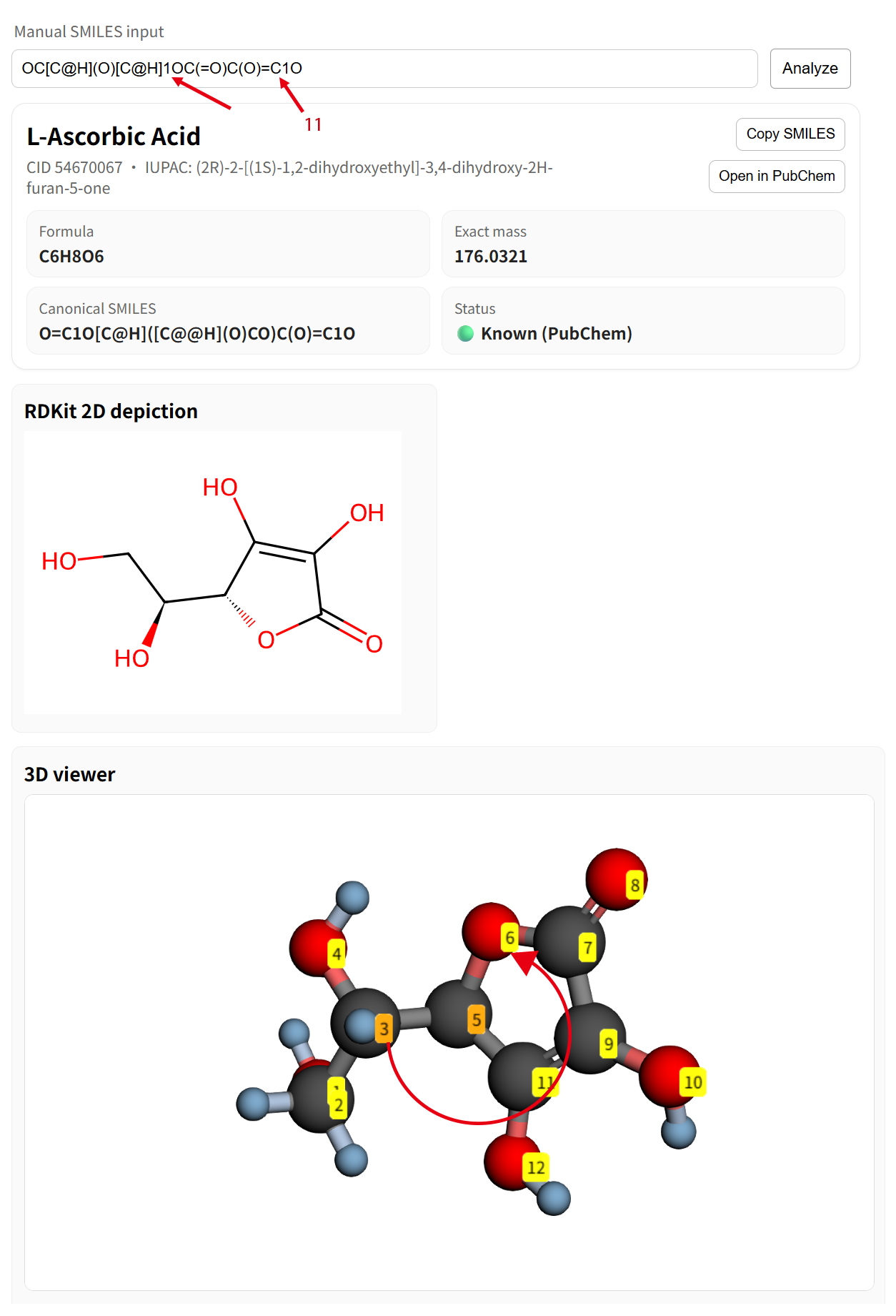
From the image above, the second stereocenter in Vitamin C is atom 5 (carbon). Place the hydrogen attached to this carbon at the back; the previous heavy atom is atom 3. In the SMILES string, the ring index 1 is a ring-closure placeholder and corresponds to atom 11 (the carbon attached at the matching 1). So the next atom after 3 is 11 (not atom 6 oxygen), and the sequence 3 → 11 → 6 is counterclockwise. This is also consistent with the definition of "@" in SMILES.